Friday, March 15, 2013

Being a Good Loser (or, how horses and writing are kind of the same thing)

My big non-writing activity is horseback riding. Which I've probably mentioned before, but you'll have to forgive me, the Alzheimer's is kicking in super early. If I can remember what I ate for breakfast it's a good day (which I cannot, coincidentally).

Right now I'm working on training a young, green horse. He's a gigantic Warmblood with a sweet, relatively docile disposition and so much potential you could weep over it. After a couple months of working with him I'm finally making real, visible progress, and that makes me think of writing.

The fellow in question.
When you first have this idea for a story, all you can see is this glorious picture in your mind of what the end result is going to look like. You're almost tempted not to even work on it, because you don't want to mess with that beautiful picture.

But of course, if you want to get anywhere you do have to start working. So you pull up a word doc and start writing and you're like okay, this is going somewhere, it's fine.

And then you hit a snag. An idea doesn't make sense or a character falls flat or something just feels off. It's like a bad day with the horse - everything is going fine and then out of nowhere they mutiny against every command and try to shove you around in the stall. You're left miserable, wondering what the hell happened and how you can possibly fix it if you don't even know what went wrong.

So then you have a choice. You have to decide: Is it the horse(idea)? Is it me? Or is it both, and do I want to keep working anyway?

The truth is, not every idea works and not every horse is going to work with you. Sometimes there's a personality clash and it's better to switch horses. I have a bunch of old manuscripts, some complete ones, that I finished and realized they sucked. It happens.

I guess the trick here is figuring out what's a barrier you can push through and what's a brick wall. Over time, hopefully, we get better at it. But just a few weeks ago I wrote 50 pages of a project and ended throwing them out wholesale. They weren't good enough and I couldn't make them better. I had to start over from scratch.

But then I started a new story, and it did work; it worked a hundred times better than the old one.

So maybe the key isn't to figuring out when you're playing a losing game. Maybe the key is being a good loser. If you can walk away from a failure (50,000 scrapped words, a horse that you just couldn't teach) and say, "Yeah, I failed, but I'm doing something else now and it's good."

And if it isn't good, you still start all over again.

Thursday, March 14, 2013

In or Out?

Something that a lot of people get wrong is what introvert and extrovert really means.

And introvert isn't someone who likes to be by themselves. An introvert is someone who gets their energy from alone time. Being around other people drains them. Whereas an extrovert gets energy from being around other people, and spending too long on their own will leave them lethargic and miserable.

Of course, I'm an introvert who hates everybody, so it's a moot point for me. (Kidding! Sometimes.)

I wonder sometimes how much our talents come from our personal tendencies. Writing is essentially a solitary task - yes, there are critique partners and events like NaNoWriMo, but at the end of the day, you still have to sit down and type x-ity thousand words onto the screen. And if you can hold a conversation while you think of reasons for people to explode things and fall in love, then my hat's off to you. Could you be an introverted theater manager, spending 14-hour-days directing people and overseeing everything? Maybe, but I'm not sure how.

There are probably degrees. Some people are probably fairly balanced between introvert and extrovert. Personally I'm a pretty extreme introvert; I need hours and hours of time alone to recharge after something so simple as a normal work day. And of course, a day is never as simple as just work - we come home and see family and friends and travelling royalty or whatever. In some ways I'm fortunate - I'm able to function on small amounts of sleep and I use my late-night alone time to get the bulk of my writing time. In other ways it's less fortuitous - I'm pretty sure "well rested" is a cruel myth.

Maybe there are some people out there that life comes easily for, but I don't think there are many. I think the "average" 9-5, family, friends structure of American life isn't a perfect fit for most people. We have this idea in our heads of what our lives "should" look like from TV and movies, and we forget that in real life we don't get convenient training montages with complimentary glasses. Things work differently in real life. People work differently. Life isn't a one-size-fits-all.

Tell me - what adjustments do you have to make?

Wednesday, March 13, 2013

I Write/Wrote/Will Have Written Your Point of View

Things are about to get a little tense up in here.


First person, third, or even second? Present, past, or... hey, wait, has anybody ever written a book in future tense? Serious question, people. I've never seen this before. Could be interesting: "I will leave the house today. Then I will go into the woods. I will be attacked by a bear, but the bear won't be a match for my mighty fists of fury. Then I will tame the bear and ride it into the sunset." Okay, could also be very annoying.

There's a lot of debate over what the "best" tense to use is. For a long time third person past was overwhelmingly popular, but recently there's been a surge of popularity in not only first person, but first person present. I think The Hunger Games really solidified first person present's place in current lit. Interestingly, though, there isn't a ton of third person present out there and I've noticed that when it is used, it tends to be in literary rather than genre fiction (House of Sand and Fog by Andre Dubus, Leaving Las Vegas by John O'Brien).

Only rarely do you see second person used, which makes sense - it reads as unusual to us, and it attempts to actually put us in the story, which can either be very effective or give the rhetorical question effect. "Have you ever wondered what it would be like..." "NO!"

It's quite common to have people really love one or the other. I've heard a lot of people say things like, "I won't read anything in present tense," or, "I only read books written in third person". I wonder if this is a function of familiarity, or if there's something about those styles in particular that appeals to people? Maybe some readers like the action-packed immediacy of first person present, while others prefer the distance of third person.

Right now I'm writing a romance novella in third person present. And I really, really love it, though I'm not entirely sure how cool people will be with that format. Time will tell!

Talk to me - what's your opinion on this tense subject? Do you love first person? Hate second person? Can't stand the present? Let me know!

Tuesday, March 12, 2013

Surviving the (Romantic) Suspense #4: Home Defense

As a romantic suspense author, I spend a lot of time writing about ladies in peril. And by that token, I have to get them back out of it. So I'm going to use one day a week to talk about self defense and protecting yourself in various ways.


When it comes to protecting yourself (and your shtuff) at home, the idea is to make it more of a hassle than it's worth for somebody to break in. This means you don't want to get an alarm system and then say, "Hokay, done!" You want to have multiple layers of defense in place so that anyone looking to break in has to put in that much more effort and take that much more time - therefore giving them more opportunities to get caught.

A security system is a good idea. At minimum, a sign from a security company can act as a possible deterrent.  Good locks are unfortunately not particularly useful; someone looking to get in your house is more than likely just going to break a window and either climb in or reach around to unlock your door. Good windows are very useful; hard to break windows are fantastic, and using the right kind of curtains is more important than you think. Don't give someone the opportunity to walk right up to your house and stare inside. Hang thick, opaque curtains.

Consider a dog. Just having the threat of something annoyingly yappy can help, as can the warning that barking will provide. Noise of other kinds can help too - if you leave on the TV or radio, it creates ambient noise that makes the house feel less empty.

Of course, none of these methods are foolproof, but then that's the point. If one particular method of home security worked, nobody would use anything else. The idea is to make your house seem like a difficult, unappealing target. Operate on the more is more principle. Whatever you choose to do, do a lot of it. Make your house such a pain in the butt that nobody can even be bothered to attempt to wade through the thorny bushes and storm the gate.

Monday, March 11, 2013

Poetry and Coffee: A Bit of an Odd One

This is one of my favorite poems. It's also a little strange.

The poem is a dedication in the book Seven Pillars of Wisdom. If you've ever seen or heard of Lawrence of Arabia, this is the man (and book) that movie was based on. He was known for his liaison role in the Ottoman Empire during the Arab Revolt.

Although he never confirmed it, scholars agree that "S.A." is most likely Selim Ahmed, a young Syrian boy that Lawrence was fond of. He died at age 19 from typhus, weeks before Lawrence set out to liberate Damascus from the Ottomans.

To S.A.  
I loved you, so I drew these tides of men into my hands
And wrote my will across the
Sky and stars
To earn you freedom, the seven
Pillared worthy house,
That your eyes might be
Shining for me
When I came

Death seemed my servant on the
Road, 'til we were near
And saw you waiting:
When you smiled and in sorrowful
Envy he outran me
And took you apart:
Into his quietness

Love, the way-weary, groped to your body,
Our brief wage
Ours for the moment
Before Earth's soft hand explored your shape
And the blind
Worms grew fat upon
Your substance

Men prayed me that I set our work,
The inviolate house,
As a memory of you
But for fit monument I shattered it,
Unfinished: and now
The little things creep out to patch
Themselves hovels
In the marred shadow
Of your gift.
T.E. Lawrence, 1922

Sunday, March 10, 2013

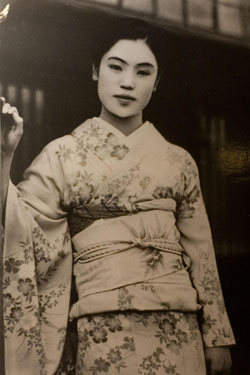
Geisha: A Very Short History

Since there was such an interest in the truth of the fascinating onna-bugeisha, I thought I would talk a bit about another group of japanese women I've spent some time studying - the geisha.

Secrecy is the byword of the karyĆ«kai (flower and willow world) that the geisha inhabit. Part of their allure is their mystery. What thoughts lie behind those carefully painted smiles?


To begin to understand something of the little we know about the geisha, first we have to understand their history. I referred a moment ago to the flower and willow world. That isn't merely a pretty name for the highly ritual, matriarchal microcosm of society that the geisha inhabit. It's a descriptor: in the old days, courtesans and prostitutes (of varying degrees of social status) were the colorful flowers, while the skilled, dignified geisha were the willows.


While geisha themselves didn't sell sex for money (sort of... sometimes... it's complicated), they descended from an elite rank of courtesans known as oiran. During the Edo period (1600 - 1868) laws were passed that restricted prostitutes to selling their wares in walled districts called yukaku set away from city centers. These yukaku quickly became pleasure quarters popular with wealthy men, and two ranks of prostitutes formed: the second-class tayu, and the elite oiran who were not only beautiful, but quick-witted and skilled in the arts besides.

Restricted inside these pleasure quarters, the oiran quickly fell out of touch with modern society and actually grew too refined to sell their wares. The ancient arts of tea ceremony, flower arranging, and calligraphy were nice, but they didn't entertain a man. It was time for something new.

Enter the geisha.


Today we think of geisha as beautiful relics of the past. But in their time they were fashion plates trained in singing and dancing... not so different from idealized women of our own time, like Beyonce. They weren't some fond remembrance, they were firmly steeped in the current culture and fashion forward. Housewives modeled their own clothes off the daring styles of the geisha.

In the beginning, geisha were actually forbidden to sell sex in order to protect the rights of the licensed courtesans (prostitution wasn't made illegal in Japan until 1956). So instead, geisha focused on ways to entertain men as equals. While mainstream japanese society dictated that women be meek and obedient, geisha were allowed to be fun. And geisha society was the one place where women were allowed to own and run businesses. In the teahouses where geisha sold their dancing and laughter, women dominated.

This, between the late 1700s and early 1900s, was the heyday of the geisha.

Saturday, March 9, 2013

Country Mouse, City Writer

Right now I'm out in the country and experiencing cognitive dissonance. In my imagination, the country is like this:


In reality, I'm more like this...


In the summer you can go raspberry picking or swim in the creek. But in the winter, well, you can be cold. Or you can be inside. And I'm fine being on my computer writing all the time, but I'm around other people, and they don't really understand that all of my thoughts live in Scrivener/Pinterest/Twitter. Which is understandable. But it means that if I sit down to try to write, everyone else takes that as a cue to engage me in conversation.

Speaking of which, time to go.


What about you? Are you a city mouse or a country mouse?