During the height of the Ottoman Empire, the sultans did not marry. There were several reasons for this - one was simply that a harem meant MOAR BABEEES, one was the elimination of a vulnerability in war if a wife was captured, and one was basically an "up yours" to all the other noble houses and their eligible daughters who weren't considered good enough for royalty.
When Suleiman met Roxelana, everything changed.
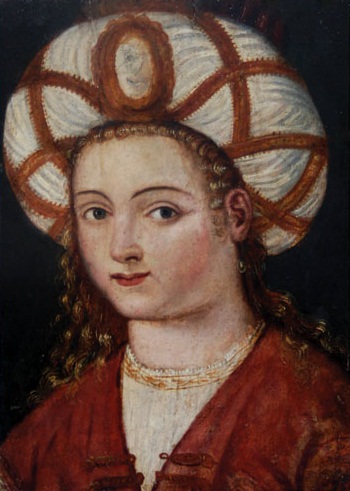 |
| A 16th-century portrait of Roxelana |
After her rival's exile, Roxelana became the haseki, aka the favorite. She asked to be instructed in the ways of Islam, and then decided to convert. Suleiman was happy about this and gave Roxelana her freedom. However, now that Roxelana was free and a converted Muslim, she told Suleiman that she was no longer able to have a relationship with him when they weren't married.
.JPG/442px-Szulejm%C3%A1n_a_s%C3%A1tr%C3%A1ban_Buda_alatt_(1529).JPG) |
| Suleiman the Magnificent suffering le royal blue balls in a 16th-century Ottoman miniature. |
Hürrem Haseki Sultan, as Roxelana came to be called, was part of the Sultanate of Women, the 130-year-long period during the 16th and 17th centuries of the Ottoman Empire where woman drove the course of history. Much of this was due to the turbulent nature of the times - when boy sultans were on the throne, their mothers would rule in their stead. But a few canny women like Roxelana ruled through their masters and husbands.
 |
| A letter of state written by Roxelana to Polish king Sigismund II Augustus congratulating him on his ascension to the throne. |
It's hard to know what Roxelana really felt for Suleiman - after all, he bought her from slavers and used her for his pleasure. However, it's important to keep in mind that while this sounds beyond horrific to our modern sensibilities, this sort of thing was normal (if not pleasant) back then. It may have been that Roxelana could find it in her heart to love her captor.
Whatever the case, it is clear that Suleiman desperately loved Roxelana. Suleiman wrote Roxelana this poem and signed it "Muhibbi", meaning "sweetheart":
Whatever the case, it is clear that Suleiman desperately loved Roxelana. Suleiman wrote Roxelana this poem and signed it "Muhibbi", meaning "sweetheart":
Throne of my lonely niche, my wealth, my love, my moonlight.
My most sincere friend, my confidant, my very existence, my Sultan, my one and only love.
The most beautiful among the beautiful...
My springtime, my merry faced love, my daytime, my sweetheart, laughing leaf...
My plants, my sweet, my rose, the one only who does not distress me in this world...
My Constantinople, my Caraman, the earth of my Anatolia
My Badakhshan, my Baghdad and Khorasan
My woman of the beautiful hair, my love of the slanted brow, my love of eyes full of mischief...
I'll sing your praises always
I, lover of the tormented heart, Muhibbi of the eyes full of tears, I am happy.
