Showing posts with label history. Show all posts

Tuesday, September 10, 2013

Top 5 Common Misconceptions

There are some things out there, some universally accepted things, that are just flat out wrong. And they baffle me. Here's a few:

1. Romeo and Juliet is a romance.

It's just... it's not! It's not! It's a tragedy! And yes, the fact that it's a tragedy does preclude it from being a romance. Here's why: a romance is defined by the fact that it has a "happily ever after", whereas a tragedy is defined by the fact that the flaws of its main characters bring about their eventual demise. The reason something is tragic is because a person brings an entirely avoidable situation upon themselves.

Plus, I really just fail to see anything romantic about Romeo and Juliet's relationship. It's a couple of tweenagers who get the hots for each other after meeting at a party. Did you find American Pie romantic? Well then.

2. Napoleon was super short.

I wish more people would use this Jean-Léon Gérôme painting
when they talked about Napoleon.
No, British people are just too lazy to convert into metric. At the time, French inches were longer than British inches. Napoleon was 5'2" in French inches, which made him 5'7" in British inches - not only was he not short, he was actually above average height for the time.

But he was all conquering everything, so the Brits needed something to make them feel better, I guess.

3. Pride and Prejudice is a romance.

Also not a romance! It's a social commentary that revolves around the social station of one family, and in particular the situation of Lizzie Bennett, who happens to draw the eye of Mr. Darcy. Their relationship goes from adversarial to a sort of friendship to romance, but the book isn't really about their romance; love is more like the deus ex machina that saves the reputation of the Bennett family at the end. Darcy and Lizzie spend maybe 30% of the novel together at best. And remember that famous line from the novel - "In vain I have struggled; it will not do. You must allow me to tell you how ardently I admire you." I wonder how many people remember that Lizzie rejects Darcy after that speech?

It took me a long time to like Pride and Prejudice because I went into it expecting a romance. It's not. It's a brilliant social commentary, but when your heroine falls in love with the hero out of gratitude for saving the reputation of her little sister... not so much with the knee-buckling.

4. Anastasia and Thumbelina are Disney movies.

Nope, they're just blatant rip-offs! Back in the early 90s Disney was making bank off The Little Mermaid and Aladdin, so famous animator Don Bluth basically sold out and tried to copy Disney. It worked, too, sort of - Anastasia was Don Bluth's most successful movie, although it didn't stop Fox Animation from going under anyway.

5. Cleopatra was beautiful.

Hawt.
It's an unfortunate commentary on society's lens that it's assumed if a woman is powerful and attractive, she must be conventionally beautiful.

Plutarch: "For her beauty, as we are told, was in itself not altogether incomparable, nor such as to strike those who saw her; but converse with her had an irresistible charm, and her presence, combined with the persuasiveness of her discourse and the character which was somehow diffused about her behaviour towards others, had something stimulating about it."

Translation: She had plain looks but a brilliant mind and a charming demeanor.

Tuesday, May 28, 2013

Poetry for the Beginning of the Work Week

For those of us fortunate enough to have yesterday off, anyway. Hope you had a lovely weekend and Memorial Day!

So, Samuel ibn Naghrillah! An Adalusian Jew fluent in both Hebrew and Arabic, he was a Talmudic scholar living in Iberia under Moorish rule circa 1000AD. He was almost unique in that he was an elite of both Jews and Arabs, and he played a huge role in Muslim-Jewish relations. Samuel went from being a shopkeep to being the vizier of the king, and playing kingmaker to the line of succession in order to put the more widely favored candidate on the throne. He made it all the way to the head of the Muslim army, which is not just an astonishing feat for a Jew at that time, but at any time.

He also wrote poetry. I'm not entirely sure when this guy slept.


The Apple 
I. 
I, when you notice,
am cast in gold:
the bite of the ignorant
frightens me. 
II. 
An apple filled with spices:
silver coated with gold.
And others that grow in the orchard,
beside it, bright as rubies.
I asked it: Why aren’t you like those?
Soft, with your skin exposed?
And it answered in silence: Because
boors and fools have jaws.

Monday, May 27, 2013

The Sorrows of the Young Hipster

I always have to laugh when people get irritated about "these kids today". We all want to think that the next generation is the new and most annoying generation of all time.

K.
But look, hipsters are nothing new.


In ye oldeny times of 1774, Johann Wolfgang von Goethe was the owner of the world's most impressive name and writer of a novel called The Sorrows of Young Werther.

With a title like that, you know it's gotta be good. In fact, 24-year-old Goethe laid the foundation for the Romantic movement with his woeful epistolary novel detailing the doomed love between a young peasant girl and the dude who knows she's engaged before he gets all up in her business. (It was also autobiographical, which got real awkward for everyone involved, especially Goethe.) Peasant girl gets married, Werther suffers poetically a bunch, and then eventually shoots himself and dies.

This book is basically what happens if you mix Romeo & Juliet and Sherlock Holmes. Goethe ended up hating this novel and saying he "could not have been more haunted by a vengeful ghost". Arthur Conan Doyle feels your pain, bro.

"I can't help it that I'm popular."
The novel was a big success. Like, a really big success. Like, everyone quickly started wishing the book would go away.

How did this get here?
It started a trend of "Werther-Fever" where young dandies dressed like the character in the novel, showed up at Goethe's door to generally annoy him, and even committed copycat suicides. No, really. It was actually such a problem that the book was BANNED in a bunch of places.


So be grateful, I guess. Instead of duckface and Times articles, we could have yellow pants and blue jackets. And angsty poetry recitations at dawn (*shudder*).

"If I sit here awhile longer, I'll probably have a super deep thought.
Any time now. Aaaaannnnnyyyyy time."

Sunday, May 12, 2013

I Kept Misspelling France When I Wrote This Post

Let it be noted that this happened when I tried to talk to my father about Marie de France:

Me: "...and then this bird flaps into her window and just turns into this KNIGHT and then he's like no, it's cool, I'm totally not the devil because I can change into YOU and take communion, and it's hysterical."
Dad: "...Write about it on your blog."
Me: "Hmph. Fine. I will."
Dad: "Yes, I know you will."

So yeah, my father is always right, keep calm and carry on.

Okay! Today we are talking about Marie de France, BAMF of the early Medieval times. We don't actually know much about Marie de France (speculation runs the gamut from sister-in-law of Eleanor of Aquitaine to the abbess of Reading - yes, ironic, but Reading is a place. Silly France) except her name. But we do know her name, since she stamped it on EVERYTHING. She was actually the first person to do this, and she flat out says:

I shall name myself so that I will be remembered;
Marie is my name, I am of France.
It may be that many clerks
will try to take my labor as their own.
I don't want any of them to claim it.
I feel at a loss to say anything but, YOU GO GIRL!

Super flattering.
But just being a kick-ass female writer who started the trend of claiming her work wasn't enough for Marie. She also established "lais" as an art form. Lais are short rhymed stories about love and chivalry. Marie de France's work in particular is notable for its detail and impressive use of imagery. (They're also impressively bonkers in some parts. Celtic myths, you are weird. Just know that.)

Not only was she way ahead of the game in terms of the little fact that her lais, oh, signaled the END OF THE DARK AGES uh YEAH, but Marie de France's work gave a voice to women of the time. Her lais are filled with a range of characters and personalities, but all of the women seem to leap off the page with life. They have wants and needs and they try hard and they make mistakes. The women in her stories mostly want love, and Marie de France is remarkably forgiving of those women who venture outside of their marriages to seek it.

The lais of Marie de France gave women agency, and in some ways that's remarkable even now.

Scholars tend to characterize her writing as sorrowful and the women in them as inarticulate and vulnerable, but frankly I think those scholars are poopheads. The women in Marie de France's lais are often imprisoned - a literal interpretation of the restrictions on women at the time. The women take measures that are realistic for their situations. They are not confused or inarticulate at all in my opinion. Would you call this woman's words inarticulate?
"I've often heard
that one could once find
adventures in this land
that brought relief to the unhappy.
Knights might find young girls
so noble and lovely;
and ladies find lovers
so handsome, courtly, brave, and valient
that they could not be blamed for their actions,
and no one else would detect them.
If that might be or ever was,
if that has ever happened to anyone,
God, please grant me this wish."
Because I sure wouldn't.

Friday, May 3, 2013

The Art of Beauty, As Written By An Old Roman Dude

Did you know that Ovid wrote over a hundred verses of didactic poetry defending the use of makeup by Roman women?

(Okay so yes I MAY have been reading a lot of Ovid lately. I swear I reach other stuff sometimes. It's not all Greek verse and Richard Siken around here, except when it is. For instance, I just today got a book called THE HORSEMASTER which a) is hilarious comedy value and b) I am actually totally looking forward to reading.)

It's estimated that originally there were somewhere between five to eight hundred verses in Ovid's work, but this is one of those fragmented pieces that we've only been able to pick up second or third-hand. In fact, the only reason we know the title and publishing date of Cosmetics for the Female Face, aka The Art of Beauty, aka Medicamina Faciei Femineae, is that Ovid mentioned it in his second book The Art of Love which was literally a Roman era how-to-pick-up-le-hot-Roman-chicks guide. Self-help: not as recent a phenomena as people think!

The popular theory is that The Art of Beauty was a parody working off of a very well known and serious book at the time. But even if it was, so what? Just because something's a parody doesn't make its points any less valid, and all of the beauty recipes that Ovid included are actually effective skin treatments. Keep in mind that the people who study this stuff also call Ovid's efforts to move toward a concept of mutual fulfillment in his book The Art of Love "superficial brilliance". Umm hokay.

The sad fact of the matter is that a lot of scholars will dismiss something if it doesn't sound super fancy and/or is about the ladies. But I'm not convinced that everyone thought that way even in the olden times. People are complex, and there were just as many smart and tough ladies in ye olden times, even if things were harder for them, and I'm sure there were plenty of men that respected that.

Also guys this actual sentence is in the Wikipedia article for The Art of Love. I... I cannot even.

What ho, Captain, we have made a DISCOVERY!

Friday, April 26, 2013

Top Five Historical Couples: Day 5

1. Justinian and Theodora

This one is a little difficult to talk about because it takes place in the Byzantine empire between about 500 and 550BC. There are a few different sources, all of which contradict each other to some extent, and if I try to cover all the discrepancies we'll all be here until the next Ice Age. So! I'm going to give you a rough outline of supported facts and if you want to sort out what's up for debate, you can look into it further yourself.

Theodora was the daughter of a bear trainer (awesome) and an actress. She followed in her mother's footsteps and became an actress in Constantinople. Back in the day acting was seen as a highly disreputable career because a lot of the things acted out were sexual, and actresses doubled as prostitutes - but ones that didn't owe any allegiance to brothels and pimps, so they were more independent and better off.

When she was 16, Theodora traveled to North Africa. She settled in Alexandria for a time and converted to Christianity. When she returned to Constantinople she gave up acting and settled down as a wool spinner. She drew attention anyway - Theodora was known for her charm, wit, and likability. Somehow, she drew the attention of Justinian (heir to Emperor Justin I) and captivated him.

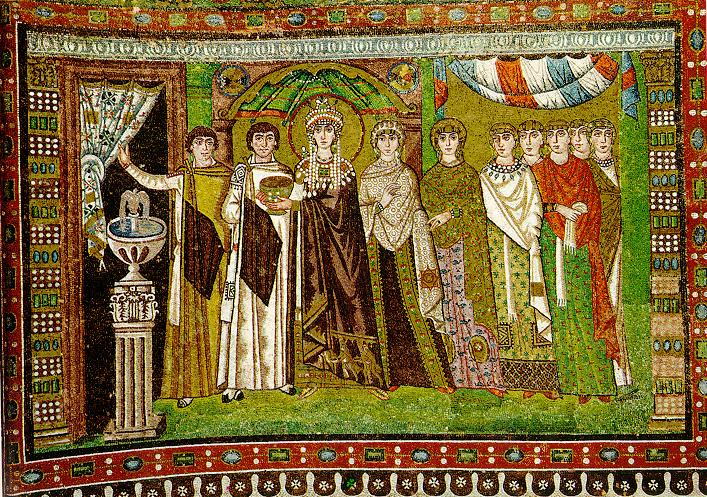
Justinian and his court
Justinian was another larger than life character, but although he usually was denied nothing, Empress Euphemia was absolutely against him marrying a common actress, and since there was a law against royalty marrying actresses at the time (seriously, Emperor Constantine made this a thing back in the day), he could do nothing.

Three years later Euphemia died and Justinian was as in love with Theodora as ever. So Emperor Justin I repealed the law, and the two were married. Theodora had an illegitimate daughter that may or may not have been his, but Justinian always treated the daughter as his own.

In 532 BC the Nika revolt occurred between two rival political factions named the Blues and Greens (because Romans, like sports fans, need easy identification of their teams). When the government was unable to quell the mob, they prepared to flee.

Theodora stepped up at the council and gave an impassioned speech, reminding the rulers that the people knew the difference between a government that was willing to stand and fight and one that would run away to exile. She told them that "purple makes a fine shroud", and also to stop being such wimps.

Her powerful speech swayed the council and saved Justinian's empire. He never forgot it.

Under Justinian and Theodora, Constantinople became the greatest city the world had seen up until that point. They focused on rebuilding aqueducts, bridges, and churches, and instituted social reforms that focused on equality. One of Theodora's proteges was a eunuch who became a great general later in life. She was the force behind a number of increases in women's rights, closed brothels, and banned forced prostitution. She forbade "exposing" unwanted babies to the elements, instituted the death penalty for rape, banned the death penalty for female adulterers, gave mothers guardianship rights over their children, and expanded women's rights in property ownership and divorce. She also founded a convent where ex-prostitutes could go to find work to support themselves.

Theodora and her court
When Theodora died in 548, Justinian is said to have wept bitterly at her funeral. What we know is that he loved her so much that he maintained her social reforms and expanded upon them. And he never married again; never sired any more children. It's impossible to prove, but as far as we know he never took another lover.

Not all Romeo and Juliet cases end in tragedy. Some end in the establishment of an empire a thousand years ahead of its time. And that is my top historical couple.

Wednesday, April 24, 2013

Top Five Historical Couples: Day 4

2. Anne Neville and Richard III

Richard III and Anne were childhood friends due to her father. Richard Neville (yeah, there were like three names total used for about 600 years, so get used to it) was the most powerful supporter of the house of York and known as the "Kingmaker". Richard III, as the third son of the York line, was important enough to be Richard Neville's squire, but not near enough the throne to be out of reach as a marriage match. The two children spent a lot of time together at Anne's home, Middleham Castle, and in 1470 they were betrothed.

But then Richard Neville switched sides. He allied himself with the Lancastrians and Anne was married  to Edward of Westminister, the son of the Lancaster house. However, the marriage was never consumated and Edward was quickly killed on the battlefield.

We know that George Clarence - Richard III's brother - was married to her sister Isabel, and took Anne on as his ward. But George wasn't exactly known for his good life choices. He was greedy and foolish, and on no authority whatsoever denied Richard III the right to Anne's hand in order to keep his hold over the whole of the Neville fortune and lands.

Anne wrote to every royal that she could think of, but nobody would help her - George was the third son of the king and Richard III was the very last son, after all.

so hawt
What happened next is an odd bit of history and subject to much debate. We know that Anne disappeared from George's clutches somehow and found her way to Richard again. But how that happened exactly is unknown. My favorite version of the story is the one where George, fearing that Anne (and her fortune) would be taken from him, sent her to work as a servant in a London cookshop, where nobody would believe her story of being a noble lady. Richard III sent his men into the city looking for any word of Anne, tracked her down, and saved her.

No matter how it happened, on 12th July 1472, Anne and Richard III were finally married at Westminster Abbey. Richard ceded a number of Anne's lands to George simply to make things smoother, but he kept one land that was important to Anne: Middleham. The two of them moved back to their childhood home and settled there. And sometime in 1473, their only son Edward (ANOTHER ONE) was born.

In April 1483, Richard III's brother Edward IV died, leaving Richard III as Lord Protectorate to his two sons and heirs. But in June of that year the two boys were declared illegitimate as a result of the country's hatred for Elizabeth Woodville, the late Edward IV's widow, making Richard III... king.

These were turbulent times where kings died as easily as they came to power, and given their move out to the country estate of Middleham, it seems likely that Richard III had no desire to be king. He'd certainly always been more than loyal to his family before and shown no signs of any hunger for power. But now they had no choice - Richard III was king, and had to do his duty.

A contemporary image of the couple. Why he's standing on a pig
I do not know and cannot tell you.
Queenship held little joy for Anne. She was crowned in 1483, and their son died suddenly in 1484. Afterward, Anne adopted Edward, Earl of Warrick, her sister's orphan (YET ANOTHER ONE). The boy was described as "simple-minded" but Richard III made him heir presumptive, apparently solely for Anne's sake, because as soon as Anne died he named a different heir.

Anne died in March 1485 in Westminster, most likely from tuberculosis. There were vicious rumors that Richard III had her poisoned in order to marry Elizabeth of York, but that appears not to have been the case since he, you know, didn't.

Richard III was said to have wept at Anne's funeral, but he wasn't parted from his love for long - only four months after her death, Richard III became the last English king to die on the battlefield.

Tuesday, April 23, 2013

Top Five Historical Couples: Day 3

3. Shah Jahan and Mumtaz Mahal

In 1631 Mumtaz Mahal, wife of the Mughal emperor Shah Jahan, died during childbirth. Shah Jahan was devastated. He vowed to build a monument so grand that the world would never forget her. The next year he began construction on this:


Shah Jahan wrote of the Taj Mahal:
Should guilty seek asylum here,
Like one pardoned, he becomes free from sin.
Should a sinner make his way to this mansion,
All his past sins are to be washed away.
The sight of this mansion creates sorrowing sighs;
And the sun and the moon shed tears from their eyes.
In this world this edifice has been made;
To display thereby the creator's glory
I know starting from the end may be in slightly bad taste, but in this case, how can you not?

There's something of a Rachel and Leah flavor to this couple's story. Anjumand Banu was born in Agra to a family of the Persian nobility. At 14 she was betrothed to Shah Jahan, but the wedding was delayed for... reasons... (the court astrologers took five years to decide on an auspicious date) and Shah Jahan was pressed to marry two other women in the meantime. When Shah Jahan and Anjumand Banu were finally allowed to wed, he gave her the name Mumtaz Mahal, meaning "Chosen One of the Palace".

File:Mumtaz Mahal.jpg
A Mughal painting of Mumtaz Mahal circa 17th century
As the court chronicler wrote:
The other wives had nothing more than the status of marriage. The intimacy, deep affection, attention and favour which His Majesty had for the Cradle of Excellence (Mumtaz) exceeded by a thousand times what he felt for any other.
Shah Jahan appears to have done his duty and sired the appropriate one child each with both other wives, and that was all. In contrast, Mumtaz Mahal had fourteen children, one of whom was the celebrated poet Roshanara Begum - a woman who never married and was known as the brilliant mastermind behind her brother Aurangazeb's ascension to the throne.

Mumtaz Mahal was so trusted by Shah Jahan that he gave her the imperial seal, the Muhr Uzah. She was involved in commissioning architecture in Agra and helped the poor. She also always traveled with Shah Jahan, even on his military campaigns.

When Mumtaz Mahal died, Shah Jahan went into mourning for a year and declared that she would never be forgotten. He appears to have been correct.

Monday, April 22, 2013

Top Five Historical Couples: Day 2

4. Suleiman the Magnificant and Roxelana the harem girl

During the height of the Ottoman Empire, the sultans did not marry. There were several reasons for this - one was simply that a harem meant MOAR BABEEES, one was the elimination of a vulnerability in war if a wife was captured, and one was basically an "up yours" to all the other noble houses and their eligible daughters who weren't considered good enough for royalty.

When Suleiman met Roxelana, everything changed.

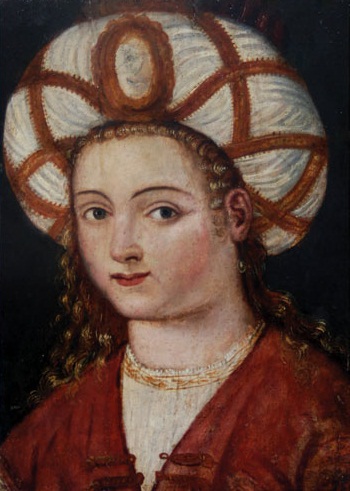
A 16th-century portrait of Roxelana
Roxelana was a Polish woman captured by slave traders and sold in the Istanbul markets. She was selected for the sultan's harem and quickly rose to prominence. A catfight erupted between her and Mahidevren, the sultan's previous favorite of over ten years and mother to the royal heir. Suleiman was so angered by the beating Roxelana received that he sent Mahidevren away to live with her son and never touched her (or any other woman) again.

After her rival's exile, Roxelana became the haseki, aka the favorite. She asked to be instructed in the ways of Islam, and then decided to convert. Suleiman was happy about this and gave Roxelana her freedom. However, now that Roxelana was free and a converted Muslim, she told Suleiman that she was no longer able to have a relationship with him when they weren't married.

Suleiman the Magnificent suffering le royal blue balls
in a 16th-century Ottoman miniature.
Suleiman held out for all of three days and then married her. This was the first royal marriage in over 200 years.

Hürrem Haseki Sultan, as Roxelana came to be called, was part of the Sultanate of Women, the 130-year-long period during the 16th and 17th centuries of the Ottoman Empire where woman drove the course of history. Much of this was due to the turbulent nature of the times - when boy sultans were on the throne, their mothers would rule in their stead. But a few canny women like Roxelana ruled through their masters and husbands.

A letter of state written by Roxelana to Polish king
Sigismund II Augustus congratulating him on
his ascension to the throne.
It's hard to know what Roxelana really felt for Suleiman - after all, he bought her from slavers and used her for his pleasure. However, it's important to keep in mind that while this sounds beyond horrific to our modern sensibilities, this sort of thing was normal (if not pleasant) back then. It may have been that Roxelana could find it in her heart to love her captor.

Whatever the case, it is clear that Suleiman desperately loved Roxelana. Suleiman wrote Roxelana this poem and signed it "Muhibbi", meaning "sweetheart":
Throne of my lonely niche, my wealth, my love, my moonlight.
My most sincere friend, my confidant, my very existence, my Sultan, my one and only love.
The most beautiful among the beautiful...
My springtime, my merry faced love, my daytime, my sweetheart, laughing leaf...
My plants, my sweet, my rose, the one only who does not distress me in this world...
My Constantinople, my Caraman, the earth of my Anatolia
My Badakhshan, my Baghdad and Khorasan
My woman of the beautiful hair, my love of the slanted brow, my love of eyes full of mischief...
I'll sing your praises always
I, lover of the tormented heart, Muhibbi of the eyes full of tears, I am happy.

Sunday, April 21, 2013

Top Five Historical Couples: Day 1


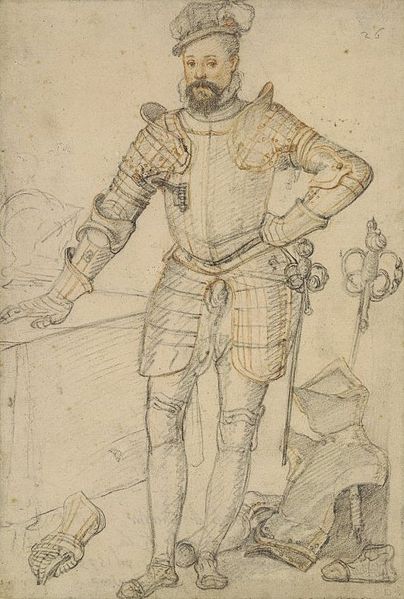
5. Queen Elizabeth I and Robert Dudley. 

ay bay bay
Sure, they were never married (he married someone else - twice, and she refused to marry anyone) and there's no historical confirmation that they were ever technically romantically involved, but their emotional affair was so well known that it still lives on to this day.

What's interesting about Queen Elizabeth and the Earl of Leicester is that they went through so many ups and downs in their 50-year-long relationship. They likely met as prisoners in the Tower of London, both holding their breath and hoping to avoid execution before Mary the Bloody died.

As soon as Elizabeth became Queen in 1558, she appointed Robert her Master of the Horse - literally, on the same day. There are hundreds of letters from various ambassadors telling their masters and mistresses about Elizabeth's love for her Knight of the Garter, who she gave as many favors and riches to as possible.

However, Robert was already married to Amy Robsart, so the two could not wed. Or... could they? Robert saw Amy for four days during the whole of 1559, and on a quiet afternoon in September, she was found dead at the bottom of a flight of stairs.

The court was in a quiet uproar. Everyone knew that Elizabeth would marry Robert now that he was free, but it was a scandal. It would make both of them look like murderers.

And then... they didn't. In fact, Elizabeth didn't marry anyone.

In some ways, it's remarkable that Elizabeth and Robert stayed as close as they did, especially when you consider the death of Elizabeth's mother. Anne Boleyn was beheaded by her husband on trumped-up charges because the man wished to marry someone else. Seeing a parallel? And years later, when Robert Dudley married the beautiful and intelligent Lettice Knollys, it was shortly after her late husband's death of dysentery... all the symptoms of which could also be caused by poison.

Robert screwed up a lot. Elizabeth reeeeaaaallly hated Lettice, dubbing the woman "the she-wolf" and disallowing her from court. He also had some dabblings in politics and war, most of which ended disastrously, one of which included him declaring himself King of the Netherlands. Elizabeth told him to shut the hell up, give the Netherlands back, and come home. He was also frequently in debt, which Elizabeth invariably forgave on behalf of the throne.

It's clear that Robert was a charming but power-hungry man who was often in over his head. And yet, Elizabeth undeniably loved him anyway. Throughout both of their lives they were as close as it was possible for two people in their position to be. It's very clear in their letters and actions that there was a huge amount of genuine affection between them, made all the more remarkable by the fact that they were two ruthless people obsessed with power.

A letter from the Queen to the Earl of Leicester,
referring to him as "her sweet Robert". One of
her nicknames for Robert was "my eyes", and
he would often dot the double o's in his letters
so they looked like eyes.

Friday, April 12, 2013

I Put a Spell On You (Okay, a Curse)

Those Romans, eh? Always invading and crucifying and cursing people. It's enough to make you think they were kind of jerks.

When you went to a Roman market, you could buy a number of things. Food, trinkets, and of course, curse tablets.

Well, obviously.
Usually the tablet itself was made of either lead or pewter. One of the reasons for this was that lead was plentiful, particularly in places like Attica or occupied Britain, where curses were particularly popular.

Once you'd purchased your tablet, you had to come up with your message, which was generally hilarious. You addressed a god, and then labeled your curse (often as a memorandum, seriously), identified the cursee, told the god their offense, and then asked for their grief or blood or small intestine or whatever.

After you were done writing the curse, you folded the tablet over and effectively scrambled the contents into the most aggressive word search ever. This was supposed to obscure the contents from the psychic vision of the cursee, and bring it closer to the god. If you were feeling particularly ambitious you could put some hair or pins inside; one discovered tablet had seven nails hammered through it. (Do NOT mess with seven-nail guy.)

Actual text: "Honoratus to the holy god Mercury.
I complain to your divinity that I have lost
two wheels and four cows
and many small belongings from my house.
I would ask the genius of your divinity that you do not
allow health to the person who has done me wrong,
nor allow him to lie or sit or drink or eat, whether
he is man or woman, whether boy or girl, whether
slave or free, unless he brings my property to me
and is reconciled with me. With renewed prayers I ask
your divinity that my petition may immediately
make me vindicated by your majesty.
The most popular place to leave your tablet seems to have been in water - either pools in temples or, oddly enough, hot springs. Another hotbed of curse activity was in, wait for it, graves. The poor undead sucker you selected was supposed to deliver your curse to Hades or actually wreak havoc itself. For whatever reason this was a practice that was almost never practiced outside of Rome proper. Perhaps Romans were so used to killing everyone that they didn't feel very threatened by the undead. ("Oh yeah we actually had a zombie horde attack the other day; nobody even noticed until after we crucified them all.")

Wednesday, February 6, 2013

Only a hundred years ahead of her time


Recently the US military opened frontline combat positions to women.

In April 1898, sharpshooter Annie Oakley sent a letter to President McKinley asking for permission to create a team of 50 women sharpshooters (outfitted and trained at their - aka her - own expense) for use in the Spanish-American War.

When her offer was declined, she raised money for the Red Cross by holding sharpshooting demonstrations. And she offered again before World War I, but the answer was the same.

In her time, Annie was known for her conservative outfits compared to her more risque female entertainers - she wanted people to pay attention to her skill, not her body. She married a man that she met when she beat him in a shooting match. She donated huge amounts of money to charity, up to and including melting down her shooting medals and donating those.

That's a woman worth making proud, and I think Annie Oakley would be proud to see every step we take closer to true equality.

A picture of the letter, from this source