Showing posts with label lit theory. Show all posts

Thursday, June 20, 2013

Good Adaptations: They exist!

WHEREIN I SAY NICE THINGS ABOUT A THING. MAYBE TWO THINGS. No, really!

I think there are two kinds of good adaptations when you come right down to it: those that take the source material apart and remake it into something different, and those that want you to experience the source material as exactly as possible.

Kenneth Branagh's Hamlet is one of the latter. Check out this exchange (and I'm picking one with R&G just because I love them and Rosencrantz and Guildenstern are Dead):

GUILDENSTERN
The queen, your mother, in most great affliction of
spirit, hath sent me to you.
HAMLET
You are welcome.
GUILDENSTERN
Nay, good my lord, this courtesy is not of the right
breed. If it shall please you to make me a
wholesome answer, I will do your mother's
commandment: if not, your pardon and my return
shall be the end of my business.
HAMLET
Sir, I cannot.
GUILDENSTERN
What, my lord?
HAMLET
Make you a wholesome answer; my wit's diseased: but,
sir, such answer as I can make, you shall command;
or, rather, as you say, my mother: therefore no
more, but to the matter: my mother, you say,--
ROSENCRANTZ
Then thus she says; your behavior hath struck her
into amazement and admiration.
HAMLET
O wonderful son, that can so astonish a mother! But
is there no sequel at the heels of this mother's
admiration? Impart.
And now look at the Kenneth Branagh version:


Kenneth Branagh's version of Hamlet is set 200 years in the future, and yet, there is no actual content changed. He uses the medium of film very effectively to emphasize funny or sad bits, and to keep the audience engaged with characters like Ophelia who might normally fade into the background, but all of the dialogue is exactly the same.

This is not a mark against his creativity. Kenneth Branagh wanted to bring Hamlet to life, and he did it wonderfully.

So, then there's the other way.

The Eagle is a (sadly) little-known 2009 Channing Tatum and Jamie Bell movie that was marketed as a historical action movie instead of the character study it really is. This isn't even one of these movies where you have to dig for the true meaning - nope, every single last bit of it is about the relationship between two men whose relationship changes from master/slave to brothers.

Look at this film clip, and then read the text of the book, of the same scene:


And in the book:
“Are you sure that you can trust that barbarian of yours in a venture of this kind?”  
“Esca?” Marcus said in surprise. “Yes, quite sure.” 
The other shrugged. “Doubtless you know best. Personally I should not care to let my life hang by so slender a thread as the loyalty of a slave.”  
“Esca and I—” Marcus began, and broke off. He was not going to make a circus show of his innermost feelings and Esca’s for the amusement of such as Tribune Servius Placidus. “Esca has been with me a long time. He nursed me when I was sick; he did everything for me, all the while that I was laid by with this leg.”  
“Why not? He is your slave,” said Placidus carelessly.  
Sheer surprise held Marcus silent for a moment. It was a long time since he had thought of Esca as a slave. “That was not his reason,” he said. “It is not the reason that he comes with me now.”  
“Is it not? Oh, my Marcus, what an innocent you are; slaves are all— slaves. Give him his freedom and see what happens.”  
“I will,” said Marcus. “Thanks, Placidus, I will!”
The beauty of this is that both scenes hold exactly the same content. Both are about a wounded ex-soldier hearing about his father's legion's lost eagle and deciding to take his slave on a quest to win it back from the wilds of Britain.

What the filmmakers did - which, frankly, I think is brilliant - was to keep the story the same but change the relationship between Marcus (the ex-soldier) and Esca (the captive slave).

In the book, Marcus and Esca share an instant connection, and have to figure out how to navigate being friends around the boundaries of their different cultures and baggage. Marcus doesn't understand Esca, but watching him try earnestly is rewarding enough to carry us happily through the book. There's this wonderful line about walking in without leave near the beginning that really encapsulates the slow burn of their relationship:
He never asked about those days, nor how Esca had come into the Calleva arena, because something about his slave, some inner reserve, warned him that to ask would be an intrusion, a walking in without leave. One day, perhaps, Esca would tell him freely, but not yet.
(Amazingly, this is not a romance. I think. But they do settle down and build a farm together and never marry I AM JUST SAYING.)

In the movie, Esca is bought for Marcus against his will and they bond in spite of themselves: Marcus is bitter about his discharge from the army and Esca is bitter about being enslaved. We the audience see that these two men are kindred spirits, wounded fighters struggling to find a purpose in life, and over the course of the movie we watch as they slowly come to this realization themselves. The movie is also much more intense, which fits an action-packed hour and a half as opposed to the leisurely stroll we take through the book. (I'm just sayin, there isn't any tearful, "I thought I lost you," in the book. And yes that actually happens. God, this movie was marketed so poorly.)

Both are valid interpretations of a relationship between two unfortunate but noble men, and notably, each is more palatable to the culture it comes from. Mid-1900s Britain (where Rosemary Sutcliff wrote) understood the fatalistic nature of two men who could accept a rough hand dealt to them and keep pushing forward. America circa now might not get that attitude, but two bitter characters who find solace in each other despite themselves... well, you can see how that might resonate.

All this is to say that, while there are a hundred thousand ways to mess it up, it's also possible to make a good, valid adaptation that adds something to the source material. Personally, I prefer movies and books like The Eagle that allow me to look at the source material in a different way... but that just leads me to the zillion and a half incarnations of Sherlock. And I don't want to get into that.

Do I?

*sob*

Tell me what your favorite adaptations are in the comments! :D

Friday, June 7, 2013

Why Are You Torturing Me With Your Artistic Vision

Aka, the bad side of adaptations, as requested.

I think that we can all agree that when you adapt something, you don't want the adaptation to be identical. That would be purposeless. You want to make slight changes in order to further explore the source material (the different interpretation of the central relationship in The Eagle book and movie) or open understanding of the material to a wider audience (Lord of the Rings).

It's really difficult to succeed at this in a way that will both delight fans of the source material and draw in new fans of your adaptation. Luckily, there's thousands of ways to fail!

Most books or movies have a few key themes or ideas. For instance, The Chronicles of Narnia = Jesus is Awesome and His Dark Materials = Atheism is Awesome.

Hello, boring children. I think I'd rather just sit through
a sermon than have to follow you lot.
Both of these movies fail in similar ways. Love it or hate it, both of these books are all about their respective messages, and both of their movie adaptations were afraid of treading too heavily. So they softened the messages, focused on the characters, and thereby weakened the story. In a story that's all about a theme or idea, the characters tend to be more symbols than actual personalities. If you try to tread lightly on the message, then you darn well better beef up the characters.

If Narnia had tried to give its characters personalities past "young and nice", "older and nice", "boy and nice", "sulking wonder", it might have worked. But they chose to stick with the book "personalities", when those characters are basically symbols. Susan is simply not as nuanced or interesting as a crownless king who spends 80 years playing in the mud rather than trying to get his throne back.

Then there's movies that try to explore different aspects of the source material, like Tim Burton's adaptation of Charlie and the Chocolate Factory.


Yeah... this poster is pretty accurate.
While the book and the 1971 movie are Charlie's story, the 2005 movie focuses on Willy Wonka himself. Rather than being an entertainingly vicious morality tale about the boy equivalent of Cinderella, the 2005 movie focuses on... Willy Wonka's daddy issues.

(P.S. Tim Burton, you should get those looked at.)

It's too bad, because it's clear that a lot of time and money and love went into the 2005 movie - the sets are gorgeous, the actors are carefully directed, and there's a lot of neat twists like having each musical number come from a different decade. But unfortunately, the film fails, because the movie simply does not work as Willy Wonka's story.

Part of the problem is that Johnny Depp's stammering, serial-killer-grin performance just isn't all that likable. But a bigger issue is that the mechanism for the story is Charlie going through all these tests to see if he's worthy. So now we've divided our focus for the movie - we've got a saintly kid going through tests to determine his worthiness, and a cheshire smile weirdo freaking out over his daddy issues. The tension in the movie is divided in half: will Charlie prevail, and will Wonka spank his inner muppet? This wouldn't necessarily be a huge problem if we liked or cared about both characters; unfortunately, we care about neither.

The original movie/book worked so well because we had interestingly awful characters failing the tests around Charlie while Wonka was fascinatingly menacing in the background. The 2005 movie zooms the lens in on Wonka, but strips him of his interest by making him quirky instead of menacing, and delving into a past in a way we never wanted to. Less is more, filmmakers, when are ya gonna learn that? After you've remade every horror movie ever, I'm guessing.

And then there's movies that try hard, but completely miss the boat in every direction. So how about that John Carter? Aka, the biggest box office disaster since Cutthroat Island (another movie you've likely never heard of, that looks like a Pirates of the Caribbean knock-off but was made almost a decade earlier).

John Carter is interesting, because it doesn't fail so much as an adaptation as it just fails as a movie.

How interesting. A dude on a thing.
There's definitely a marketing element to the "where did we go wrong" - - John Carter? Who? Release a show named Sherlock and we get it, but John Carter doesn't have the same cultural resonance that it had 60 years ago, and Disney, you should have known that. I know that non-horror science fiction movies are generally about as successful as The Host, but at least John Carter of Mars TELLS us something. Hell, you couldn't go with A Confederate on Mars? Something, anything!

But I think the real problem is that A Princess of Mars (the book this movie was adapted from) simply was never a very compelling story to begin with. It got popular because it was in the right place at the right time. It was one of the first planetary romances (that term, uh, doesn't mean exactly what it sounds like) and had the proper "swashbuckling":"cool space shit" ratio to keep audiences happy. It didn't get famous for being good, it got famous for being first-ish. So as a movie, well, it's another "white guy stumbles into a war and wins it for the natives" story. And, uh, we have a lot of those.

And then there's movies that fail completely to have any understanding at all of their source material. Let's look at Angus, Thongs, and Perfect Snogging, an adaptation of a YA novel. Here's a quote from the source material:
“Looking out of the window at the infinite sky, I prayed out, 'Dear Baby Jesus, I am sorry for my sin, even though I do not know what they are, which seems a bit unfair if it is going to be held against me. But that is your way. And I am not questioning your wisdomosity. In future, however, would it be possible for my life to be not so entirely crap? Thank you.” 
Now here's a scene from the movie:


Oh. Oh, wow. Oh... ow, actually. That was physically painful.

The book barely has a plot; it's the diary entries of a boy-crazy and completely self-centered teen girl. It follows her for a year... and that's pretty much it. The book's strength is in its absolutely hysterical prose. The main character's observations on life are hilarious and memorable.

The main characters do fairly closely
resemble their literary counterparts.
That's about the highest praise
I'm able to give this movie.
The movie is... I don't even know what this is. It's like a Disney made-for-TV movie where even Disney said, "We have too much shame to air this." The movie is true to the plot of the book (such as it is), but instead of expanding on or even using the hilarious source material, attempts to amuse us through humiliation. The girls in the books embarrass themselves occasionally, yes, but the humor comes from what they learn (or choose not to learn) from their experiences.

Love can't always win the day, and it certainly doesn't always make a good movie. (Try again, Tim Burton, there's always Alice in Wonder... oh.) Complete disinterest towards your source material probably won't, either. The thing is, it's always easier to fail than it is to succeed.

I think the key may be in understanding what makes the source material work. We love endless incarnations of Sherlock Holmes because that relationship between a cold, brilliant man and his loyal companion is so very compelling. You can interpret this any number of ways and we'll be interested. Sherlock Holmes is a fairly easy hook to get right, and so you see a lot of at least decent interpretations of it. But then there's movies like The League Of Extraordinary Gentlemen that overload on empty plot and CGI rather than delving into our characters, which were the whole hook to begin with!

Adaptations are like any art: you have to understand the rules in order to break them. Understand how a story works, and you'll be able to rearrange it into something captivating. Fail to understand that, and you get...

Awwwwwwww HELL no.

Tuesday, May 21, 2013

I Volunteer as Leader

And now we come to the end of this extended cut of sacrificial kingship as a concept, what happened this got so out of control. It's just... I just love this theme so much, and, and, I got carried away, and...

Hokay, so. When last we left off, we'd established that the idea of a king as a noble leader willing to sacrifice himself for his people is fundamentally rooted in our worldwide mythology. That's why we all love characters like Aragorn, who are willing to sacrifice not only their lives but also their personal happiness for their people.

That's all fine and well in a fantasy setting where you have pure evil and pure good, but is it really relevant in a modern-day context? Does the divine right of kingship have a place in the modern world?

Let's talk about Tom Bombadil for a hot second.

He's of the jolly, beardy sort.
In case you've forgotten him, or never read The Lord of the Rings (since they wisely left him out of the movies), Tom Bombadil is the most powerful character in LOTR. Gandalf and Elrond and everybody says so. He could hold the One Ring forever and never be corrupted by it. And if Middle Earth fell to Sauron, he would be the very last to fall.

But none of that matters, because it's not in his nature to fight. He will not take a stand against Sauron, and therefore all the power in the world doesn't matter. Lesser men are forced to do the things he technically could do - but won't.

In ye oldeny days and even now, leadership and goodness are often conflated with genealogy. There's a few reasons for this - one is that when kings were running things you needed justification for their rule and you wanted to be reassured that the right guy was in power. And also, it's just easy. Heyyy, this guy is awesome because God made him born into this family, therefore he was MEANT to do this job. Abracadabra.

I like to think we've made a bit of progress. Leadership abilities are not restricted to a particular gene pool - or a particular gender, for that matter.

Instead, I propose the notion of sacrificial leadership. Where the strength of character to lead others and be willing to sacrifice yourself (or at least a part of yourself) for them comes from within whatever you are.

A really great example of this is Katniss in The Hunger Games. Don't worry, no spoilers, although it applies to later events in the series too... But all we really need to look at is the very beginning.

They’re not our kids, of course. But they might as well be. Gale’s two little brothers and a sister. Prim. And you may as well throw in our mothers, too, because how would they live without us? Who would fill those mouths that are always asking for more? With both of us hunting daily, there are still nights when game has to be swapped for lard or shoelaces or wool, still nights when we go to bed with our stomachs growling.
When her father dies, twelve-year-old Katniss chooses not to give up. She chooses to provide for the sister she loves and the mother she doesn't. She puts their welfare ahead of her own, feeds them when she can't feed herself. And of course, we all know that she makes the ultimate sacrifice for Prim.

“Prim!” The strangled cry comes out of my throat, and my muscles begin to move again. “Prim!” I don’t need to shove through the crowd. The other kids make way immediately allowing me a straight path to the stage. I reach her just as she is about to mount the steps. With one sweep of my arm, I push her behind me.
“I volunteer!” I gasp. “I volunteer as tribute!”

This doesn't only apply to life-or-death situations. In my upcoming book, the hero is a rich CEO who runs the family business out of duty. He knows that he has the means to employ a large number of people and to make positive changes in the world, so he feels that it would be irresponsible to step down and just dabble in hobbies and have fun for the rest of his life.

So yes, as much as I have always loved the theme of sacrificial kingship in literature/film, I think we've moved past the idea of divine right. Nobody deserves anything because they happened to be born in a certain situation. But life isn't about what we deserve. Life isn't fair. We have to make the best of what we have and the best of what's inside us. We can use the term sacrificial leadership to encompass heroes and heroines both past and present. Some people are born leaders, and (at least in literature) in order to complete their character arc they need to embrace that ability in themselves and be willing to sacrifice themselves (or part of themselves) for the greater good.

Like Aragorn.

Tolkien once killed a man in an outlining contest.
Just, not like his crown.

Sunday, May 19, 2013

Fishing for Kings (Sacrificial Kingship Part 2)

So! Now that we've gone into the background of modern thinking about mythologic archetypes, we can talk about two particular concepts: the sacred king and the maimed king.

The sacred king was the cornerstone of Frazer's theories about ancient civilizations. In his work, he postulated that in the past, the life and eventual death of kings represented and growth and death of the vegetation, a "dying and reviving god". This human king provided for his people for a time and then eventually was sacrificed back to the earth. (I have some problems with this theory... namely that back in ye oldeny times most people were nomadic and didn't do a ton of agriculture... but this is about lit theory and therefore my historical issues with it really aren't relevant.) In any case, this connects to the fact that both in ancient and far more modern history, some kings are viewed as sacred beings. This could mean that the king was credited with good fortune. Or it could mean that your people view you as responsible for their well-being and sacrifice you in order to get a better harvest next year.

The maimed king (also known as the Fisher King, as he was referred to in T.S. Eliot's poem The Waste Land) seems to come from Arthurian legend. In the tales, this king was wounded so that he suffered from impotence, and his lack of fertility affected the earth around him and turned it into a barren wasteland. This legend is super freaking weird in all of its incarnations (there's a version where this king asks his followers to cut off his head and then his head keeps talking and keeps them all company on their trip back to Britain idk idk guys the Celts were weird). In any case, when purehearted people eventually come fetch the Grail he was hanging onto and this somehow heals him, his restoration represents the growth of vegetation in spring. Rebirth, if you like.

SO. These are cool and all, but not terribly interesting concepts unless you're super into agriculture and ye olde civilizations that may or may not have been nomadic. So why talk about them at all?

Because I think that these are necessary concepts if you want to understand what sacrificial kingship is and why it works. The idea of a king being responsible for the fate of his people, and being willing to lay down his life for their good, is deeply embedded in not just one culture, but essentially every culture. While history tells us that kings are flawed and often corrupt, our legends and mythology tell us a very different tale. Belief in the goodness and rightness of our kings is practically part of our DNA.

It's why characters like Aragorn work in fiction. We see from his introduction in The Fellowship of the Ring that although Aragorn is a good leader and has royal blood, he has no desire to be king and happily plays around in the mud while the stewards of Gondor do their thing. (Yes, I know that the films gave him all this inner conflict about being Isildur's heir, because of course if your great-great-great-great-great-whatever was susceptible to corruption, so are you, because that is totally how ancestry works. This isn't in the books and it was stupid anyway so I don't care.)

The books aren't overt about it because they aren't nearly as focused on Aragorn as the movies are, but we see clearly that Aragorn is happy in his current circumstances and views kingship as a burden. There is nothing kingship could give him that he wants. He's used to living as free as it's possible for a man to be, as a nomad following whims of the moment. Kingship is a cage - as Eowyn later notes.

In fact, in the books Aragorn proposes to Arwen and she accepts, but Elrond forbids them to marry until Aragorn is king of Gondor. And Aragorn does nothing. He loves Arwen, but he loves his freedom more. You could argue that he doesn't want to upset the political situation with things being kinda shaky in Middle Earth, but know who's on the throne as steward? Denethor.

This guy is definitely a savvy political player; I foresee no problems at all.
While in the movies Aragorn has to achieve self-actualization and gives himself lots of hugs, in the books Aragorn's arc is him eventually deciding to put the needs of others before his own needs and becoming king despite his own wishes. We get a bunch of lines like, "I have come because Gandalf begs me to do so." and, The hobbits still remained in Minas Tirith, with Legolas and Gimli; for Aragorn was loth for the fellowship to be dissolved. "At last all such things must end, but I would have you wait a little while longer." Also this: "I have," said Strider. "I dwelt there once, and still I return when I may. There my heart is; but it is not my fate to sit in peace, even in the fair house of Elrond." 

And while in the movies Boromir is all tetchy about GONDOR HAS NO KING; GONDOR NEEDS NO KING; EFF YOU ASSATHORN, in the books Boromir flat-out begs Aragorn to come fight for Gondor as its king. "I was not sent to beg any boon, but to seek only the meaning of a riddle," answered Boromir proudly. "Yet we are hard pressed, and the Sword of Elendil would be a help beyond our hope - if such a thing could indeed return out of the shadows of the past." 

And later... "Mayhap the Sword-that-was-Broken may still stem the tide - if the hand that wields it has inherited not an heirloom only, but the sinews of the Kings of Men." 
"Who can tell?" said Aragorn. "But we will put it to the test one day." 
"May the day not be too long delayed," said Boromir. "For though I do not ask for aid, we need it. It would comfort us to know that others fought also with all the means that they have."

The ending in the book is not a happy one for Aragorn. He is forced to take up his right of kingship and do his best by the people of Gondor, no matter what he would rather his fate be (and, just to rub it in, Gondor does have peace under his reign as he sits on the throne - just like he claimed his fate wasn't). It's not a tragedy of course, but his happiness is qualified by the fact that he'd rather be somewhere else doing something else. BUT he's a good king doing right by his people, which takes precedence over personal happiness.

But what about divine right of kingship and that whole ickyness, you may ask? Does blood (either through ancestry or sometimes trial by combat) really justify kingship? Does it matter?

Well... Check back for part 3.

Thursday, May 16, 2013

The King is Corn, Let's Eat

WHO WANTS TO TALK ABOUT SACRIFICIAL KINGSHIP?!

Yeah, well, too bad.

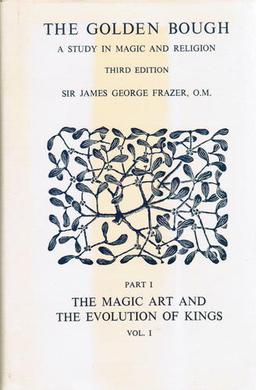
In 1890 a Scottish guy named James Frazer published The Golden Bough and everyone immediately dove for their fainting couches. The Golden Bough was a comparative study of mythology and religion that analyzed both alike from a dispassionate perspective. His analysis concluded that human thought progresses over time from belief in magic to belief in religion to belief in science. While that seems like a common enough thought now, back in the day if you didn't go to church every Sunday they started gathering logs in anticipation of the witch-burnin' party. (Not really, but back then effectively everyone was religious. Atheism was almost unheard of.) So to analyze religion from an anthropological standpoint was revolutionary, and in fact completely revitalized the field of anthropology.

By the third edition this sucker
expanded from one volume into
TWELVE. 
While most people today haven't heard of The Golden Bough, almost everyone has heard of the people whose work was self-admittedly influenced by it (this sentence structure and verb/noun agreement is so horrendously awful that I actually decided to keep it instead of edit. Such horror must be preserved), including but not limited to: Sigmund Freud, James Joyce, Ernest Hemingway, D. H. Lawrence, Aleister Crowley, Ezra Pound, William Gaddis, Mary Renault, T.S. Eliot, William Butler Yeats, and H.P. Lovecraft.

One of the main things that The Golden Bough tried to do was to isolate the shared ideas of different religions and myths into clearly defined elements - such as fertility rites, human sacrifice, sun worship, etc. Frazer's hypothesis was that old religions were fertility rites that revolved around the worship and eventual sacrifice of a sacred king. The king symbolized plants and I swear to God I am not just making this up. Basically the idea was that the life and death of a chosen king (who also symbolized the sun) mirrored the growth and death of the crops that kept people alive.

Also this Anthropologist/Egyptologist named Margaret Murray (born 1863) wrote a bunch of stuff about how she believed that there was this huge underground cult of pagan covens that practiced frequent human sacrifice until they were driven underground by the witch hunts that started around 1450. Included in this writing was the idea that a bunch of English Kings like William Rufus were secret pagans. And this woman was a professor at University College London and published by Oxford University Press. Academia in the early 1900s, you are crazy. And this really had nothing to do with anything but I thought it was hilarious.

This looks legit.
Sooooo this post is getting way long already, so I think this is gonna be a 2 or 3 parter. Those of you that aren't passed out in front of your computer by now, very good. You have been edified or something.