Monday, April 8, 2013

I Was Born To Love a Man Wrapped in Sunshine


Sunshine Days and Foggy Nights - - James Kavanaugh
I was born to catch dragons in their dens
And pick flowers
To tell tales and laugh away the morning
To drift and dream like a lazy stream
And walk barefoot across sunshine days.
I was born to find goblins in their caves
And chase moonlight
To see shadows and seek hidden rivers
To hear the rain fall on dry leaves
And chat a bit with death across foggy nights.
I was born to rub my hands in dirt
And walk green hills
To plant corn and make bread
To build a house strong against the wind
And to live free across sunshine days.
I was born to watch owls in dark forests
And hear coyotes cry
To feel trees tremble and the grass sleep
To taste cold air and smell the damp earth
And watch ghostly shapes disappear across foggy nights.
I was born to love a man wrapped in sunshine
And dressed in fog
To make a pact on a high hill
Ratified centuries ago by the sun
To walk together through sunshine days and foggy nights.

James Kavanaugh was a fascinating man. He served as a parish priest up until 1967, when he published a book called "A Modern Priest Looks at His Outdated Church", in which Kavanaugh called for church reform on issues such as birth control, premarital sex, and marriage. Originally he intended to stay in his position in the Catholic Church after his book was published, but he quickly realized that he had been naive and left the priesthood. 

His title of his first book of poetry published after he left the church seems to say everything about his feelings toward the church: "There Are Men Too Gentle To Live Among Wolves".

Throughout his life Kavanaugh called on people within the church (and outside it) to question authority and trust themselves. It was remarkable in the church environment, where unfaltering obedience was the unwritten law.

Kavanaugh continued to question everything and search for solutions that were not easy, but right. His words on self-help have stuck with me as some of the truest I've ever read:
"I burn all self-help books or tapes in which hyped heroes tell me how easy it is to put one's life together. I need those who are still wading through pain, who must struggle at times just to hang on. I don't believe in quick fixes and I'm outraged when anyone promises one."

Although it is unfortunate that The Rock lost tonight...

(probably? I mean, I don't really follow wrestling... and by "really" I mean "do they still wear the big shiny belts?")

LOOK


Don't feel too bad, guys. Instead of wrestling, The Rock will be appearing in every movie until the end of time.

Indeed, Dwayne. Indeed.

Saturday, April 6, 2013

Why is Nobody Listening to Jada Pinkett Smith?

Jada Pinkett Smith is an accomplished A-list actress, woman of color, and mother. She's extremely active in charity work. She has 3.1 million fans on Facebook.

Compare this to her husband Will Smith, who has 43 million fans. Or Justin Bieber, who has 52 million fans. Or even The Rock, who has 8 million fans.

Here's the thing about those other folks on Facebook. They update occasionally, sometimes with what even seem to be personal messages about how they hope you see a new movie they're in or about celebrating milestones.

"12 pizzas. Sent by my 2 agents.
Dominated by 1 man."
I kind of want his life.
But Jada Pinkett Smith actually talks.

On March 10th she posted a short essay titled "Are We Bullying Our Young Artists?", in which she talks about the offhand way the media treats stars as young as single digits. On March 18th she posted another short essay called "Will there ever be a day in which women will be able to see each other beyond race, class, and culture?" And on March 21 she posted a response thanking her readers for listening and commenting, and saying that she hopes they keep thinking.

Did she really read all those comments? There's no way of telling. But that's not the point. People constantly bemoan the lack of thought and leadership in the areas of diversity and education in our celebrities. Here we have a celebrity who seems to be genuinely invested in connecting with people on a personal level about these subjects, and she's ignored. Where's the news articles about Jada Pinkett Smith starting a cultural dialogue?

I'm not saying that her thoughts are necessarily ground-breaking. But Jada Pinkett Smith is trying to talk, and I'm not sure that anyone is listening.

Friday, April 5, 2013

Why I'm Not Excited About The Great Gatsby

I love The Great Gatsby. It's one of the most flawless books I've ever read. Everything about it is outstanding - the prose, the characterization, the subtlety and pervasiveness of its message. I love the book so much I have a t-shirt of its famous cover.

Looks like this!
There's been a few attempts at making a Gatsby film over the years, but the current one about to come out is being anticipated as possibly the "defining" movie for the book the way that Peter Jackson's Lord of the Rings adaptations are the best possible movies a lover of the series could ask for.

Here's the trailer.


Hear that whooshing sound? That would be the sound of $125 million worth of missing the point.

Everything about this movie is calculated to be sumptuous and beautiful. It's evident everywhere from the sweeping camera shots to the ornate gold filigree background of the text to the gorgeous scenery shots of breathtaking gardens, mansions, and cities. The characters are beautiful too, of course - Leonardo DiCaprio has had the ladies swooning since he was king of the world, and Carey Mulligan has a hauntingly fragile perfection, like a porcelain doll. The clothes are works of art. Even the emotions are grand and breathtaking, from Gatsby's overwhelming rage to his Romeo and Juliet style love affair with Daisy. And let's not forget the soundtrack ($15.99, on iTunes soon!) crammed full of today's most popular artists, and as MTV so gracefully put it, not "bogged down with tunes from the Roaring Twenties".

So basically, nothing about this movie resembles The Great Gatsby in the slightest.

The Great Gatsby is a book about the false glamour of the Jazz Age. (Do you hear me, movies?! "False glamour" is not the same thing as "glamour" and I am very tired of you assuming one is an excuse for the other.) It uses a fundamentally flawed and hollow goal - Gatsby's baseless love of and admiration for Daisy, which she doesn't deserve and isn't capable of returning - to illustrate the decayed social and moral values of American society in the Roaring Twenties.

Everyone in the book is in love with the wrong things. Gatsby wants all the things that are bad for him - money, power, a beautiful woman with an empty mind. Daisy is seduced by money, luxury, and easy living, and just bright enough to realize how meaningless this makes her life, but too lazy to care. Her husband Tom wants all eyes on him all the time; he wants universal awe and respect and genuinely doesn't realize that he's done nothing to earn it.

The eyes see everything except the point!
This movie is pretty eye candy that glamorizes a tragedy of human nature. It misses the point of The Great Gatsby so badly that it's not even in the same postal code anymore.

Am I taking this too seriously? Well, I mean, I guess you could say that. But the movie is out there purporting itself to be The Great Gatsby when it's actually Hey Look the 1920s Were Super Pretty. This isn't Fitzgerald; this is Sofia Coppola's Marie Antoinette set 120 years later.

Do you really think that the moral at the end of this movie is going to be "move to the Midwest and structure your life with traditional moral values"? Um, I doubt it. I can just about guarantee you that the end of this movie is going to be, "oh these two characters had such promise and were such bright sparks of life, and everything was thrown away! What a shame, what a pity, what a tragedy".

The book The Great Gatsby is a masterpiece that examines the falseness of human desires and the decline of the American Dream.

The movie The Great Gatsby is the story of a couple morons having a really expensive party on Long Island.

Shiny

Preeeeeeetty
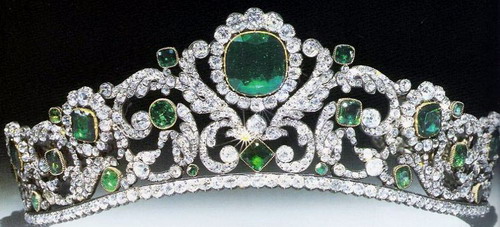
The tiara of Maria Therese is one of the only remaining crown jewels of France that was never altered in any way. Due to France's turbulent history, most of its jewels were stolen or sold off, and although some have made their way back, many were unfortunately messed with in the interim.

This beautiful tiara has over a thousand diamonds set in silver, and over 40 of France's best emeralds set in gold. There's over 79 carats of emeralds set in that thing!

I mean seriously, dang.
Maria Therese was the only member of the immediate royal family to survive the French Revolution (you know the one - guillotines all around! Guillotines for everybody except Maria Therese). After The Terror was over she married her cousin (yeahhhhh) and was Queen of France for 20 minutes between her uncle signing papers to abdicate the throne and her husband also signing papers to abdicate the throne. Everybody abdicate! Quickly, quickly!

As you can see, this is a lady that knows jewelry.
When she left for exile in Britain, she delivered the tiara to the French treasury. But stuff happened, as it is wont to do, and the tiara went on many adventures before just recently being sold back to the Louvre. It's finally home in France, where it belongs.

Wednesday, April 3, 2013

In Which I Call Medieval Scholarly Letters "Flaily Meebling"

Héloïse d'Argenteuil (who I am calling Heloise from now on, because wow those accents are inconvenient to modern people with keyboards instead of quills) was a brilliant Latin, Greek, and Hebrew scholar widely renowned for her scholarship and insight.

She lived in France, circa 1090-1164.

That's pretty amazing right there. But Heloise wasn't content just to sit around and study on her own, so she became the student of Pierre Abélard, who was a famous philosopher in Paris at the time.

As Abelard later wrote, 
There was in Paris a young creature formed in a prodigality of nature to show mankind a finished composition; dear Heloise, the reputed niece of one Fulbert, a canon. Her wit and her beauty would have stirred the dullest and most insensible heart, and her education was equally admirable. 
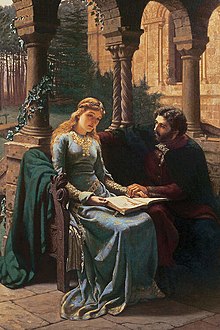
Portrait of the two lovers from the 1880s
So yeah, he liked her. And it's pretty cool that he specifically fell for Heloise because of her intelligence. Abelard put the moves on Heloise and she was suitably impressed, but actually wanted to stay unmarried because she thought it would make their scholarly pursuits more difficult.
I took a journey into Brittany in order to bring back my dear Heloise, whom I now considered my wife. When I had acquainted her with what had passed between the Canon and me I found she was of a contrary opinion to me. She urged all that was possible to divert me from marriage--that it was a bond always fatal to a philosopher; that the cries of children and the cares of a family were utterly inconsistent with the tranquillity and application which study require. She quoted to me all that was written on the subject by Theophrastus, Cicero, and, above all, insisted on the unfortunate Socrates, who quitted life with joy because by that means he left Xanthippe. 
'Will it not be more agreeable to me,' said she, 'to see myself your mistress than your wife? And will not love have more power than marriage to keep our hearts firmly united? Pleasures tasted sparingly and with difficulty have always a higher relish, whilst everything that is easy and common grows stale and insipid.' 
I was unmoved by all this reasoning, so Heloise prevailed upon my sister to speak to me.

"Will it not be more agreeable to me to see myself your mistress than your wife?" Wow. Even now this type of thinking is somewhat contrary to our culture, and I can only imagine what kind of absolutely revolutionary thinking it required back then. That's not even taking into account the "to me" of that statement: Heloise was straight up saying she didn't want to marry Abelard because SHE found it inconvenient.

Heloise apparently liked him enough to go ahead with things anyway, because they were (supposedly) secretly married. Although to be honest, I'm sort of thinking at this point that Abelard said, "My darling, I consider us married in our hearts and souls!" while draped over his fainting couch, and Heloise called back from her desk, "Yes dear, that's right, hearts and souls. No paper, baby!"

Heloise and Abelard, chilling. (14th century)
They had a son together that she called Astrolabe (a word for a type of instrument used to measure slope relative to gravity), because Heloise was quite possibly the world's first geek girl.

And then... Heloise's uncle found out about the whole "secret marriage/kid with my niece when I already told him to get off my lawn" thing. Let it be said that Heloise's uncle does not mess around. He sent armed thugs to castrate Abelard.

In solidarity with his fate, Heloise entered a nunnery and eventually became prioress and then abbess (please. You didn't think she'd just be sitting around weeping, did you?). After a few years of silence, the two of them began to correspond - although not until after Heloise scolded Abelard roundly for his lapse in communication.

When you read about Heloise, historians tend to act as though she was a sad, wilted flower who was tossed about on the stormy seas of her uncle's whims and Abelard's affections. But in reading the letters between them, and what Abelard wrote about her, I've never found that to be the case. Heloise seems strong, determined, and of course, fiercely intelligent. Their story is a tragedy, and yet it's impossible not to feel uplifted by the fact that two such remarkable people not only existed, but found each other, and loved each other.

Their discourse has fascinated people for generations, but I must admit, my plebeian soul is more moved by some of their gentler feelings than by their theological discourse. Here are some of my favorite quotes from their letters:

Lovers either find or make all things easy.


Adelard scoffs at all of you only now rounding second base:
In the dead of night, when Fulbert and his domestics were in a sound sleep, we improved the time proper with the sweets of love; not contenting ourselves, like those unfortunate lovers, with giving insipid kisses to a wall, we made use of all the moments of our charming interviews.
I find this both sweet and hilarious. Dude seriously needed to get a grip, and I have the feeling that Heloise was shaking her head at his flaily meebling, charmed despite herself:

As I was with her one day alone, 'Charming Heloise,' said I, blushing, 'if you know yourself you will not be surprised with the passion you have inspired me with. Uncommon as it is, I can express it but with the common terms--I love you, adorable Heloise! Till now I thought philosophy made us masters of all our passions, and that it was a refuge from the storms in which weak mortals are tossed and shipwrecked; but you have destroyed my security and broken this philosophic courage. I have despised riches; honour and its pageantries could never wake a weak thought in me, beauty alone has stirred my soul; happy if she who raised this passion kindly receives this declaration; but if it is an offence?--' 
'No,' replied Heloise, 'she must be very ignorant of your merit who can be offended at your passion. But for my own repose I wish either that you had not made this declaration, or that I were at liberty not to suspect your sincerity.'
From much later on, this is a pretty heart-wrenching account of Heloise trying to reconcile herself to her new life after :
My quiet has indeed cost me dear, for I have bought it at the price of my love; I have offered a violent sacrifice I thought beyond my power. But if I have torn you from my heart, be not jealous; God, who ought always to have possessed it, reigns there in your stead. Be content with having a place in my mind which you shall never lose; I shall always take a secret pleasure in thinking of you, and esteem it a glory to obey those rules you shall give me.
And although Adelard attempted to convince the both of them to resign themselves to their fate, it is clear in his last letter to Heloise how deep his feelings still truly go:

I will for the last time open my heart to you;--I am not yet disengaged from you, and though I fight against my excessive tenderness for you, in spite of all my endeavours I remain but too sensible of your sorrows and long to share in them. Your letters have indeed moved me; I could not read with indifference characters written by that dear hand! I sigh and weep, and all my reason is scarce sufficient to conceal my weakness from my pupils. This, unhappy Heloise, is the miserable condition of Abelard. The world, which is generally wrong in its notions, thinks I am at peace, and imagining that I loved you only for the gratification of the senses, have now forgot you. What a mistake is this!
But I think my favorite part of their letters is this beautiful passage written by Heloise herself, on the power of the written word:

By a peculiar power love can make that seem life itself which, as soon as the loved object returns, is nothing but a little canvas and flat colour. I have your picture in my room; I never pass it without stopping to look at it; and yet when you are present with me I scarce ever cast my eyes on it. If a picture, which is but a mute representation of an object, can give such pleasure, what cannot letters inspire? They have souls; they can speak; they have in them all that force which expresses the transports of the heart; they have all the fire of our passions, they can raise them as much as if the persons themselves were present; they have all the tenderness and the delicacy of speech, and sometimes even a boldness of expression beyond it. 

Monday, April 1, 2013

G.I.Joe and the Case of Realistic Misogyny

I went to see G.I.Joe: Retaliation, and it was a pretty fun watch! It was basically like watching a two-hour-long commercial. Things happen because WE SAY SO and now the characters are over here because of REASONS and they know things because BOOM! EXPLOSIONS! EXPLOSIONS EVERYWHERE!

So yeah, if you were willing to accept that this movie was, in fact, the equivalent of taking little army dolls and moving them from room to room in a house and making them spout catchphrases at each other, it was good times.

One thing in particular that I noticed about this movie was its portrayal of women. There are two women in the movie, and they speak to each other, not about a man. Bechdel, check! And while there were hints of a romantic subplot, it was only a hint and only in one scene, and actually only used to further the characterization of the main female character Jaye.

I really liked Jaye. She made smart choices, didn't once get kidnapped or rescued, and didn't take any crap.

Roll call! From left to right - Jaye, Joe, and that guy
played by The Rock.
Which is where we come to the point of this blog post.

G.I.Joe: Retaliation has one of the most realistic portrayals of misogyny that I've seen in a movie, ever. It's subtle and pervasive, and that's what makes it so true to life.

Bruce Willis plays Joe, the former head of the G.I.Joes. When he first meets Jaye, he calls her Brenda, and then insists on calling her Brenda throughout the rest of the movie. Does he do anything similar to her two male companions? No, of course not. And when he needs someone to get him something, he asks her. Here's the dialogue exchange that really hit home for me:

Joe: Pass me that pen, would you Brenda?
Jaye: First a Girl Scout, and now I'm a secretary. My name's Jaye.
Joe: It's just a pen.

This is what misogyny looks like, people. It's almost never the blatant "When I want to create a female character, I think of a man and I take away the reason and the accountability," of Jack Nicholson in As Good As It Gets. Usually it's small, subtle jibes that pile up over time, and women are laughed at and called oversensitive when they try to point them out - just like what happens to Jaye.

What I liked about this movie was that Jaye never just accepted it. She let it go - as women are often forced to do in the face of larger issues, like nuclear missiles with less security than a 711 lockbox - but she keeps pushing back and forcing Joe to acknowledge her as an equal. From later in the movie, after a fight...

Joe: You alright?
Jaye: Yeah. Are you alright?
Joe: ...Fine. Cholesterol's a little high.
Jaye: *extravagant eye roll*

And to give this movie its due, I do think that we're meant to find Joe's persistent sexism grating. By the end of the movie he swallows his pride and calls Jaye by her name in a scene that, while a little overdone, has its heart in the right place.

She actually has LESS cleavage in the movie
than in a kiddie cartoon.
That's all I ask for. So thanks, G.I.Joe. You served admirably. HOOAH!